Vail’s Park City/Canyons deal ushers in Era of the
Interconnect
Today’s announcement of Vail Resorts’ $182.5 million
deal to buy Powdr Corp’s Park City Mountain Resort
and connect to its neighboring Canyons Resort gives a huge
boost to Utah’s One Wasatch plan to connect seven ski
areas accessed by one lift ticket.
Besides being the first link in the network, the Park
City/Canyons connection alone will create a
7,000-acre-plus ski complex that will immediately rank as
the largest in the United States once the lifts are in
place by the 2015-16 ski season (pending government
approvals).
But One Wasatch – a concept
announced last spring
by trade association Ski Utah and endorsed by all seven
resorts – would create an 18,000-acre, 100-lift
interconnected complex that would rank among the great ski
networks in the world.
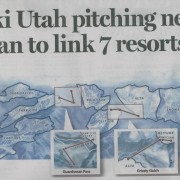
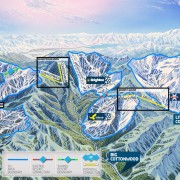
With six relatively simple lift connections, One Wasatch
would link Park City/Canyons (more than 7,000 acres) and
Deer Valley (2,026) in the Park City area to Brighton
(1,050) and Solitude (1,200) in Big Cottonwood Canyon and
Alta (2,200) and Snowbird (2,500) in Little Cottonwood
Canyon.
Six of those seven resorts (excluding Canyons) are already
part of the
Ski Utah Interconnect, a guided $325 backcountry experience that can be done
with standard alpine equipment. One Wasatch would add
Canyons and connect all seven with lift access. No hiking
necessary.
In fact, the seven ski areas mentioned are so close
there’s very little hiking required now, as I discovered
when
I skied the Interconnect in 2006. Touring between ski resorts and ski towns is a uniquely
European ski experience, and to some degree will stay that
way even if One Wasatch comes to fruition, because Utah’s
only real ski town on par with Breckenridge, Telluride,
Aspen, Steamboat and Vail is Park City. Little and Big
Cottonwood Canyons just contain ski areas.
Still, Utah will suddenly have a lot more to offer than
“just” some of the best powder skiing on the planet.
Besides serving up consistently deep snow a mere 35 to 40
minutes from Salt Lake City International Airport, the
state will have a truly European-style
interconnected alpine skiing experience
that could make it a threat to Colorado’s skier-day
dominance in the United States.
Since hosting the 2002 Winter Olympics, Utah has seen its
skier days climb from 3 million to 4 million a season, but
that still pales in comparison to Colorado’s 12 million
skier days a season – by far the most in the nation. The
One Wasatch concept is one that’s
been around for decades.
If bigger is truly better, however, a combined Park
City/Canyons complex and eventually the One Wasatch
interconnect will give Utah something Colorado can’t
compete with in terms of sheer acreage. The closest any
Colorado resort can come to 7,300 acres is Vail’s 5,289,
which makes it the largest single-mountain resort in North
America.
The largest ski complex on the continent is
Whistler/Blackcomb – linked by an incredibly soaring
gondola — at 8,171 acres. Vail Resorts could come close in
Colorado if it were to someday link Vail with Beaver Creek
(1,818 acres) – a complex that would total 8,107 acres.
But that interconnect remains a distance fantasy of Vail’s
founding fathers that would require a permitting miracle
given the amount of public land involved, although at one
point Vail did own the Meadow Mountain ski area (now a
tubing hill) between the two resorts. Now it also contains
the local Forest Service headquarters after Vail sold the
property years ago. The town of Minturn also might have
something to say about such a plan, although there are
some
advocates of a Minturn ski portal
living in that funky old railroad town at the bottom of
the Minturn Mile – a famous backcountry ski egress off
Vail Mountain.
Environmentally speaking, I think lift-connected resorts
make a lot of sense, removing cars from the roads and
encouraging public transportation in general. Park your
car for a week and get around on free shuttles and lifts.
Better yet, take a shuttle from the airport and leave your
car at home.
Telluride has just such a commuter gondola linking its
truly classic ski town to the swanky real estate
development of Mountain Village, and one resort complex in
Colorado that could rival One Wasatch is Aspen.
Connect all four Aspen ski areas — Snowmass, (3,332
acres), Aspen Mountain, (675), Aspen Highlands (1,040) and
Buttermilk (470) — and you’d have some of the best skiing
on the planet linked up into a 5,517-acre complex. Of
course, that’s still just a little bit bigger than Vail.
But an Aspen interconnect would be a game-changer in
Colorado, allowing people to stay in Snowmass Village and
ski over to the quintessential mining-town-turned-ski-town
of Aspen and vice versa. That’s what’s really attractive
about interconnects for the average tourist. It’s not so
much the ski-terrain access as it is the ability to tour
between ski towns, have lunch somewhere else and ski back.
There’s been talk of connecting some of the Aspen
mountains in the past, such as
Snowmass to tiny Buttermilk
(site of the globally renowned Winter X Games) through
Burnt Mountain, but that plan drew opposition from no less
a luminary than
ski mountaineer Lou Dawson.
Part of the charm of skiing in Europe is touring between
quaint ski villages, wining, dining and touring back. A
Vail-to Minturn-to-Beaver Creek-to-Edwards connection
could achieve something like that in Colorado, but there
would be huge opposition from environmentalists, some
Minturn residents and backcountry skiers seeking to
protect their private stashes.
From Vail’s Outer Mongolia Bowl you can see the slopes of
Beaver Creek to the west and Copper Mountain to the east,
but – unlike the Utah resorts – there are huge swaths of
public land in between. Plus you now have the question of
whether Vail Resorts and Powdr Corp. will ever be able to
play nice again after months of bitter litigation at Park
City.
Former Park City owner Powdr owns Copper, which sits
between Vail and Vail Resorts’ Breckenridge ski complex.
But the distances are so much greater than the Wasatch ski
areas, and there’s the matter of all that public land in
between in Colorado. It’s mostly all private in Utah.
That includes arguably the best skiing in the state at
Alta/Snowbird, where expert skiers who like to hike will
continue to congregate rather than the intermediate
pitches of Park City, which fit so nicely into Vail’s
quiver of big but relatively benign resorts like Vail,
Breck, Keystone and Heavenly.
And
Snowbird is now owned
by the Cumming family, which also owns Powdr, so that’s
another complicating factor in the One Wasatch equation.
Ironically, Dick Bass, brother of
former Vail owner Harry Bass, recently sold Snowbird to Ian Cumming.
If you’re a true expert skier, you don’t really go to
Colorado to ski Vail or Utah to ski Park City or Lake
Tahoe to ski Heavenly. You’re more likely to be drawn to
Aspen, Crested Butte or Telluride in Colorado,
Alta/Snowbird in Utah and Squaw Valley/Alpine Meadows in
Tahoe.
Which brings me to another interconnect scenario involving
another Colorado company, KSL Capital Partners. Lake
Tahoe’s many resorts are in some cases closely grouped and
ideal for Euro-style interconnects, but that’s especially
true of KSL’s Squaw/Alpine complex, which no less of an
industry expert than Warren Miller would like to see
connected all the way to Homewood.
Right now Squaw Valley (3,600 acres) and Alpine Meadows
(2,400) are side by side and can be skied in one day on
one ticket, but the interconnect is
less than ideal. That
could change in just a few years
if a deal can be
worked out
with the private resort of White Wolf in between the two.
Locals there are pumped about what would then be the
largest interconnected ski complex in the United States at
more than 6,000 skiable acres, but with the Park City deal
now in the books, they’ll ultimately have to settle for
second best in the U.S. and third in North America.
Regardless, it’s clear that with no new ski areas being
built in the last couple of decades and none on the
horizon, we’ve boldly entered into the Era of the
Interconnect.
Link:
http://goo.gl/LzCyU0




 Local residents understandably have their doubts. Fears
about the region’s natural beauty, homogenizing the
different resort experiences, and continued ski area
expansion are major areas of concern. As always, change
and uncertainty bring reticence, especially when it
concerns Utah locals’ favorite pastime – powder
skiing. From Alta’s laid-back attitude to Deer
Valley’s service-first mantra, resort experiences at
Utah’s seven central Wasatch resorts could hardly be
more different. But having the ability to access these
different resort cultures on one pass — whether it’s
the personality of its guests, the makeup of the terrain,
the architecture of its buildings, or the culinary
experience at their lodges — would culminate into an
experience much greater than the sum of its parts. For
the Utah snow-sliding faithful, what once was a reluctance
to change might soon become a healthy addiction. Straying
just one ridgeline away from their regular powder stash
would offer an entirely new experience. One Wasatch offers
visitors and locals alike new vistas, runs, culinary
experiences, and, perhaps most importantly, new chairlift
conversations. Everyone would see an entirely different
perspective.
Local residents understandably have their doubts. Fears
about the region’s natural beauty, homogenizing the
different resort experiences, and continued ski area
expansion are major areas of concern. As always, change
and uncertainty bring reticence, especially when it
concerns Utah locals’ favorite pastime – powder
skiing. From Alta’s laid-back attitude to Deer
Valley’s service-first mantra, resort experiences at
Utah’s seven central Wasatch resorts could hardly be
more different. But having the ability to access these
different resort cultures on one pass — whether it’s
the personality of its guests, the makeup of the terrain,
the architecture of its buildings, or the culinary
experience at their lodges — would culminate into an
experience much greater than the sum of its parts. For
the Utah snow-sliding faithful, what once was a reluctance
to change might soon become a healthy addiction. Straying
just one ridgeline away from their regular powder stash
would offer an entirely new experience. One Wasatch offers
visitors and locals alike new vistas, runs, culinary
experiences, and, perhaps most importantly, new chairlift
conversations. Everyone would see an entirely different
perspective.